Monday, June 30, 2014

A Review of 'Romeo and Juliet' by William Shakespeare

"Romeo and Juliet is a tragedy written early in the career of playwright William Shakespeare about two young 'star-cross'd lovers' whose deaths ultimately unite their feuding families.

I was among Shakespeare's most popular plays during his lifetime and, along with Hamlet and Macbeth, is one of his most frequently performed plays.  Today, the title characters are regarded as archetypal young lovers."

I'm taking a class that is all about Shakespeare this semester-- I love it!  I really like reading Shakespeare and feeling capable enough to read and understand Shakespeare!  It's glorious.

I originally read this book for my ninth grade English class, but now I'm back in my second year of college to read this book again.  I'm really glad that I got to read this again.  I understand it much better than I did when I was fourteen/fifteen years old (wow, ninth grade was six years ago... that's weird...).  Upon opening this book again, I realized how annoying Romeo is.  Half the time I wanted to smack Romeo for being so freaking love-sick and mopey all the time.  It was especially frustrating because even when he met Juliet, he was like this when things weren't working out so well.  He's know her for maybe a week or two by the end of the book.  It's a miracle that Romeo's life lasted this long if he falls in love so hard every time he sees a woman.  He's a ridiculous character...

But by the end of the play, I felt more sympathy for him.  I could see that his pain was real.  Sure, maybe he's loved Juliet for less than a week and that's really weird to me, but by the end of the play, his desperation is just oozing out of him.  He sees no way around his suicide.  His speech about going to die is powerful.  I've decided to write my first paper about that particular speech in the context of the rest of the play.

Overall, I'm really happy that I read this play again.  I feel like I have a better understanding of the connections between the characters and of the general plot.  By the time I finished the play, I fell in love with the play-- more than I did in ninth grade.

I give 'Romeo and Juliet':
Thanks for Reading!

--Jude

Monday, June 23, 2014

A Review of 'The Wolves in the Walls' by Neil Gaiman

"Lucy hears sneaking, creeping, crumpling noises coming from inside the walls.

She is sure there are wolves in the walls of her house."

I have a new life goal: read everything that Neil Gaiman has ever written.  No matter if it's a children's book like this one, a graphic novel, or a regular novel of all kinds.  I will read them all.

This is kind of a freaky children's book.  Not because there are wolves in the walls of young Lucy's house, but the pictures are verging on grotesque.  The pictures are what scared me a bit.  The art style is interesting, for sure.  It's like a mixture of illustration and photography... like collage.  It has a really eerie feel to it and I just enjoyed Dave McKean's work so much.  If I didn't like the writing, I would buy this book any way purely for the art.
But I do like the writing!  It's witty and sometimes it sets my teeth on edge.  To me, it felt like everyone was in on a secret while Lucy was stuck outside.  They all knew that when the wolves leave the walls, then that's it-- that's the end.  But Lucy had never heard this before.  Does the rest of her family know that there are wolves living in their walls?  Are they just biding their time until the wolves finally come out of the walls?

If you're a fan of Neil Gaiman, dark stories, and charming children's books, The Wolves in the Walls is definitely a good pick for you.

I give 'The Wolves in the Walls':
Thanks for Reading!

--Jude

Monday, June 16, 2014

A Review of 'The Lost Boy' by Greg Ruth

"Nate's not happy about his family moving to a new house in a new town.  After all, nobody asked him if he wanted to move in the first place.  But when he discovers a tape recorder and note addressed to him under the floorboards of his bedroom, Nate is thrust into a dark mystery about a boy who went missing many, many years ago.  Now, as strange happening and weird creatures begin to track Nate, he must partner with Tabitha, a local girl, to find out what they want with him.  But time is running out, for a powerful force is gathering strength int he woods at the edge of town, and before long Nate and Tabitha will be forced to confront a terrifying foe, and uncover the truth about the Lost Boy."

I went to a mini book convention that took place on my college campus.  I got a book called Journey there as well.  I finally got around to reading this one after having a dry spell with graphic novels.

My favorite part of this book was the illustrations.  I'm not sure how to describe what they're like, so here are a few examples (click the pictures for larger views):

It's like a cross between a photograph and fantasy.  I'm not sure if I can explain it better than that.  No matter what the explanation is, I really like the style.

But there's still a story to be told alongside these images.  I think the story has potential, but it wasn't executed as well as it could have been.  I don't think, any way.  The overall story is an intriguing one.  I like the idea of a tape recorder being left in the floor filled with clues.  I like the idea of small animals and insects being the go-between for humans and this magical land.  What I didn't like was how there were a few parts that took me by complete surprise.  Like, there was no lead-up to what would happen next.  I was in the control of the author and I didn't like that.  When it comes to books, I want a chance to be able to figure out what happens next.  There were no clues as to who this tree guy was that kept popping up randomly.  I would have read a longer graphic novel if it meant that those loose ends could be tied up a little more.

That being said, I'll be keeping my copy mainly for the illustrations and also for the rare gold nugget in the story itself.

I give 'The Lost Boy':
Thanks for Reading!

Thursday, June 12, 2014

Predeparture: Start Learning Dutch

One of my goals is to learn (some) Dutch while I'll abroad in the Netherlands.  But I don't want to be a blank slate as soon as I set foot in Amsterdam, I want to be able to say some useful phrases or at least have a very basic understanding of how the language works.  So here are some things that I've been doing to start learning Dutch:

1. Listening to Dutch Speakers on CDs.  I got a set of CDs that's supposed to help you learn the basics of Dutch and eventually master it.  I think my CDs are intended for people traveling to the Netherlands on business, which is unfortunate, because while I'll make transactions in businesses (buying food, probably making an IKEA run, buying a bike and a phone, etc.), that's the extent of my involvement in business.  I don't need to know how to run a board meeting in Dutch.  The CDs are helpful, but they haven't been my go-to method of starting out in Dutch.

2. Watching and Listening to Dutch speakers on YouTube.  There's a book-tuber that I absolutely adore (who responded to me via GoodReads, which I was really excited to see!  She gave me great tips about the Netherlands and Dutch people.  I'm eternally grateful) who happens to be Dutch.  She's great to listen to when she speaks Dutch because she speaks slowly and enunciates so that I can hear practically every letter.  That's exactly what I want!


3. Listening to Music in Dutch.  I've had trouble finding authentic Dutch music that isn't considered traditional, but a lot of the movie music that I like in English, I've also been able to find in Dutch!


Laat Het Los (Let It Go) as sung by Willemijn Verkaik has been a favorite lately.  I love that this is a lyrics video because I can see the word, I can hear it, and since I love to sing, I can say the words almost up to the speed Willemijn has set.  Willemijn has also played Elphaba from Wicked three times in English, German, and Dutch.  She's my hero.


I currently don't have close relationships with anyone who is Dutch, so this is what I do to practice without having a speaking partner!

Thanks for Reading!

--Jude

Monday, June 9, 2014

A Review of 'Radio Shangri-La: What I Learned in Bhutan, the Happiest Kingdom on Earth' by Lisa Napoli

"Lisa Napoli was in the grip of a crisis, dissatisfied with her life and her work as a radio journalist.  When a chance encounter with a handsome stranger presented her with an opportunity to move halfway around the world, Lisa left behind cosmopolitan Los Angeles for a new adventure in the ancient Himalayan kingdom of Bhutan-- said to be one of the happiest places on earth.

Long isolated from industrialization and just beginning to open its doors to the modern world, Bhutan is a deeply spiritual place, devoted to environmental conservation and committed to the happiness of its people-- in fact, Bhutan measures its success in Gross National Happiness rather than in GNP.  In a country without a single traffic light, its citizens are believed to be among the most content in the world.  To Lisa, it seemed to be a place that offered the opposite of her fast-paced life in the United States, where the noisy din of sound-bite news and cell phones dominate our days, and meaningful conversation is a rare commodity; where everyone is plugged in digitally, yet rarely connects with the people around them.

Thousands of miles away from everything and everyone she knows, Lisa creates a new community for herself.  As she helps to start Bhutan's first youth-oriented radio station, Kuzoo FM, she must come to terms with her conflicting feelings about the impact of the medium on a country that has been shielded from its effects.  Immersing herself in Bhutan's rapidly changing culture, Lisa realizes that her own perspective on life is changing as well-- and that she is discovering the sense of purpose and joy that she has been yearning for.

In this smart, heartfelt, and beautifully written book, sure to please fans of transporting travel narratives and personal memoirs alike Lisa Napoli discovers that the world is a beautiful and complicated place-- and comes to appreciate her life for the adventure it is."

Lately, I've taken to doing an online quiz that tests how many countries/nations of the world that you know.  I have been able to name about 160 of those countries and Bhutan is one of them.  So I'm happy to say that I knew where Bhutan was prior to reading this book!  What I didn't know was: absolutely everything about Bhutan.  So I'm really happy that I read this memoir of Lisa Napoli's experiences with Bhutan and the Bhutanese people.

I like that this book is unlike Eat, Pray, Love in that Lisa wasn't super desperate when she went off to Bhutan.  She is divorced and she's not very into her job any more.  She she rolls with the punches.  When she's presented with an opportunity to go to Bhutan, she goes.  Not necessarily because she has to, but because she wants to.  I like that Lisa's journey was purposeful (at least to begin with).

I also like that while Lisa is in Bhutan, she makes observations and compares those observations with what she knows about the U.S.  What I like even more is that she observed with a level head-- she wasn't in-your-face pro-America (saying that the United States way is the only way), but she picked out things from Bhutan that she loved.  She recognized what she could bring home with her and what would be best left in Bhutan.  This shows her personal growth and also makes what she's writing accessible to her reader.

One more thing that I liked was how Lisa experienced the real Bhutan.  One of my favorite parts of this book was when she flew back to the U.S. after her first visit to Bhutan.  She meets with a woman who went through Bhutan the way tourists do.  This other woman paid a ton of money to live in luxury for two weeks for a family vacation.  They visited Buddhist temples and lived in relaxation.  Lisa, on the other hand, met and befriended Bhutanese people and lived as they did (although, probably a little better, to be honest).  It was interesting to see that stark contrast.

My one complaint was that this book, after Lisa returned from her first time in Bhutan, kind of dragged on.  I think this is because I was anticipating this book to end when she re-entered the U.S., but that wasn't the case.  There was no warning for this (that I found) and it just threw me off.  I think if I read it again, it wouldn't bother me.  I think including more than one stint in this book is beneficial.  Lisa has a really broad knowledge of Bhutan now and by visiting more than once and hosting a Bhutanese girl in her home, she really shows this.

Overall, this book is good for those who like memoirs, travel, and other cultures.

I give 'Radio Shangri-La':
Thanks for Reading!

--Jude

Monday, June 2, 2014

A Review of 'Number the Stars' by Lois Lowry

"Ten-year-old Annemarie Johansen and her best friend Ellen Rosen often think of life before the war.  It's now 1943 and their life in Copenhagen is filled with school, food shortages, and the Nazi soldiers marching through town.  When the Jews of Denmark are 'relocated,' Ellen moves in with the Johansens and pretends to be on of the family.  Soon Annemarie is asked to go on a dangerous mission to save Ellen's life."

For a long time, I thought I had read this book, but I'm not sure that I have anymore.  Glad I read it now!

It's nice to get a look at what it was like during World War II in a place that isn't Germany or Poland.  Honestly, when I think WWII, I don't think of Denmark, even though they're right on top of Germany, geographically speaking.

I liked that this book provided information on what happened to those who weren't Jewish and living in the vicinity of Nazi Germany and also talked about what European Jews were going through at the time.  This was a well-rounded reading experience.  Great for those who are being introduced to what the Holocaust was for the first time.  There's tension of course, but it can't be categorized as horror.  That's why it's a good starting place.

I give 'Number the Stars':
Thanks for Reading!

--Jude

Monday, May 26, 2014

A Review of 'The Paris Wedding' by Kimberley Petyt

"A must-have for the best wedding inspiration and resources in Paris.

America's love affair with Paris spans generations.  For many, Paris is the epitome of sophistication, good taste, style and romance.  The Paris Wedding is a full-color, idea-packed, go-to guide for globally minded trendsetters who are in love with the style and romance of Paris..  Not just a resource of practical information for those planning a wedding IN Paris, but The Paris Wedding is also a stand-alone handbook full of stylish tips and glamorous photography to help add that Parisian je ne sais quoi to any celebration.

Kimberley Petyt is the owner of Parisian Events, a wedding and event-planning agency catering to English-speakers in Paris.  She writes the popular blog 'Parisian Party: Tales of an American Wedding Planner in Paris.'  She was also a monthly columnist for the nationally distributed The French Paper, where she wrote for more than a year about living and working as an expat in Paris.  Petyt and the business have been featured in print publications such as Real Simply Weddings, Get Married Magazine, Essence Magazine, Eco-Beautiful Weddings, Cosmopolitan China, and France Magazine.  Most recently, she was featured in the New York Times Magazine 'Summer 2011 Travel' issue, highlighting her skills as a cultural liaison for brides seeking to marry in Paris.  Ms. Petyt lives in Paris."

Sometimes I wonder what you think of me when you come visit this blog and see what I've been reading.  Books about depression, teen pregnancy, reviews of books that aren't necessarily popular and reviews of books that are REALLY popular, and now books about Parisian Weddings.  What on earth?

Parisian Weddings (at least the ones that take place in Paris) are actually a lot more complicated to organize than I thought they were.  You can't just go over there and have a traditional church wedding.  It takes a lot of paper work and a lot of convincing.  I thought that was interesting.  When I visited France, I wasn't there long enough to figure out how much they like paperwork, but this is the second or third book I've read that says how many hoops you have to jump through just to get a certain detail established or to procure a place to get married and a person to marry you.  Holy...

For those who aren't looking to get married in Paris, there are tons of decorating ideas and tips for shopping in France for different things that you might want for a wedding where you live.  It's very thorough... I didn't realize the amount of work that it takes to pull together a wedding (ceremony and reception).  Even if you're not getting married anytime soon, like me, it's still a fun read with exquisite pictures.  You learn a bit of culture from this book.

If you're looking to get married soon or are just looking for design ideas, this is a great book to start with!

I give 'The Paris Wedding':
Thanks for Reading!

--Jude

Monday, May 19, 2014

A Review of 'Witches!: The Absolutely True Tale of Disaster in Salem' by Rosalyn Schanzer

"In the little colonial town of Salem Village, Massachusetts, two girls began to twitch, mumble, and contort their bodies into strange shapes.  The doctor tried every remedy, but nothing cured the young Puritans.  He grimly announced the dire diagnosis: the girls were bewitched!  And then the accusations began.

The riveting, true story of the victims, accused witches, crooked officials, and mass hysteria that turned a mysterious illness affecting two children into a witch hunt that took over a dozen people's lives and ruined hundreds more unfolds in chilling detail in this young adult book by award-winning author and illustrator Rosalyn Schanzer.

With a powerful narrative, chilling primary source accounts, a design evoking the period, and stylized black-white-and-red scratchboard illustrations of young girls having wild fits in the courtroom, witches flying overhead, and the Devil and his servants terrorizing the Puritans, this book will rivet young readers with novelistic power.

Taught in middle and high schools around the U.S., the 17-century saga remains hauntingly resonant as people struggle even today with the urgent need to find someone to blame for their misfortunes."

When I worked in Barnes & Noble, I remember walking through the children's section while shelving books and this little book caught my eye.  The Salem witch trials was an incredibly interesting (and terrifying) time in history and I just love learning about it.  This is a great place to start.

It's pretty thorough as far as dates go.  It's also interesting because they go through each part of this historical event: what the society was like where the trials took place, who the people were who accused witches (witches could be anyone: men, women, animals...), and who the accused were.  I like that this book also includes an aftermath.  I didn't know what happened after the trials ended and you needed harder evidence to convict someone of witchcraft.

This is a great starter book that adults (like me) and younger readers will like, especially if they're interested in history.

I give 'Witches!'
Thanks for Reading!

--Jude

Monday, May 12, 2014

A Review of 'Dear Diary, I'm Pregnant: Ten Real Life Stories' by Anrenee Englander

"Chosen by the New York Public Library's 'Books for the Teen Age' list and hailed by 'The Globe and Mail' for its '...frank, revealing and brave conversations,' this is a must-read book for young women looking for reassurance that they are not alone.

In poignant and insightful interviews, Anrenee Englander presents the voices of 10 pregnant teens as they discuss their experiences and choices around motherhood, adoption and abortion.  First published to critical acclaim in 1997, this new edition updates the original interviews and includes a new introduction and a new resources section.

Presenting different points of view, 'Dear Diary, I'm Pregnant' is a nonjudgmental source of information for all teens that provides support and guidance for those who find themselves in this difficult situation."

I'm not sure what possessed me to pick up this book in the first place, but I did and I'm glad that I read it.  While I don't have to face such a big challenge as being pregnant and having to make this decision so young in life, I can recognize that this could be an incredible resource for young people in the world (well, at least in the United States and Canada, since that's where the resources section directs you).  I want to have this book in my classroom someday.  I'm planning to teach at the middle or high school level, where teen pregnancy is not super common (you don't see every girl walking around campus pregnant, for sure), but it's definitely a thing.  Sexuality is being worked out, experimentation occurs, and sometimes accidents happen.  This book is great because it not only lays out your choices, but you're reading the stories of girls/women who were pregnant as teenagers.  You can read about what their experiences were and why they made the decision they made.  You can also learn how they felt afterwards-- if they'd wished they'd kept the baby instead of getting an abortion or if they'd gotten an abortion or put the baby up for adoption instead of keeping it (although I don't think there are any stories where the mother decided to keep the baby and then changed their mind after).

Even if these experiences aren't your own, I think it's still good to read for understanding.  There are too many misconceptions about teen pregnancy and girls who do get pregnant get a lot of crap for being pregnant.  Most of the time, it's an accident and the girl in question has to make a huge decision that will change the rest of her life.  I feel like I realized that before reading this book, but these personal accounts just reinforces what I only thought I knew before.

When I'm a teacher, I'm going to create a resources shelf that isn't related to school at all and this book is going to be on that shelf.

I give 'Dear Diary, I'm Pregnant':
Thanks for Reading!

--Jude

Thursday, May 8, 2014

The Minnesota History Museum

I went on another field trip with my fifth graders at Northrop.  This time, we spent the day at the Minnesota History Museum.  When I was in elementary school, I remember going to this museum.  The fun thing was, a lot of the exhibits that were there when I had visited with school were still there.  So I was able to walk into different places with the fifth graders and say, "Hey, I really liked this one!  Let's go see this exhibit!"  But before we went and explored the museum, we had an hour or so of class time where they learned about the fur trade:


This was a really neat lesson that was put together.  It was very interactive and the kids loved it.  They got to line up, put on the beaver skin hat, hold the other animal skins that were sometimes used for trading (beaver skins were the most coveted-- everyone in Europe wanted a beaver skin something until silk became the popular material.  They got to hold some things that people who lived back then would have wanted: a trap, some food, tools, and yes, even a musket.  They gave a kid a gun (unloaded, but it was enough to give me a little bit of a heart attack.  People, don't hand ten-year-olds guns).

With these things that were traded, they played a game similar to Deal or No Deal.  They "had" a total of 15 beaver skins and they had to bargain with the owner of the trading post (the museum volunteer) with their beaver skins.  At the end of the game, they got to see how many beaver skins their object actually would have cost them.  Such a neat way to show that.

 A couple of the kids got to dress up as Voyageurs (see upper left).  They were taught that every piece of clothing that the Voyageurs wore had a special purpose for all seasons.  They learned about the Voyageur lifestyle and it was really neat to see them get into what the Museum representative was talking about.

After their lesson was done, the adults took their small groups and we went and explored the whole museum for the rest of the time that we were there.  I lucked out and got my favorite group of girls-- they read with me on Thursdays when I come and they get really into talking about the books they're reading.  So here are some of the places that we visited around the museum:
As soon as we got our instructions from the Museum Volunteers, my group asked excitedly if we could be the first at the tornado basement exhibit.  We ran out of the classroom, bounded up the stairs, and swung into the "basement" before any other group could even think about getting to the basement.  I love this exhibit.  It's about the tornadoes that were in Fridley, MN and how that affected the lives of those who lived there at the time.  You watched the TV, listened to the radio to figure out what was going on, and all the while, you could feel the ground shake beneath you and watch the window change as the storm came and went.  It was like experiencing a mini tornado.  It's awesome and the kids loved it.
 There was a small exhibit about living in a sod house.  Outside the house, there was a plow that you could run either as the person pushing the plow, or as the cattle pulling the plow along the rows that would later be used for planting.

This was a neat activity.  A big part of Minnesota history is the various groups of Native Americans.  A big part of some of their cultures is the buffalo.  There was a "dead" buffalo on the ground and nearby was a scanner.  You could take apart the buffalo, removing organs, bones, skin... everything.  You'd take those parts over to the scanner, scan it, and see what the Native American groups used that part for.  It was really cool.  They liked holding the different parts and "discovering" what was done with the different parts of the buffalo.  Super cool.

This was an exhibit that I had never been in before.  It must be relatively new.  You pick a helmet, walk into the "elevator," and walk through this mine and learn about what miners did and how they lived.  You could try everything from drilling into a wall of coal, drop dynamite and blow a wall apart, and look around (note: everything that sounds dangerous to try out was just pretend.  Just so you know...).  It was really loud and equal parts dark and bright, but this was a really neat place to visit.
This is sort of what a classroom looked like at the Native American boarding schools.  This is where many Native Americans were forced to part with the culture they had grown up with.  They had to cut their hair and were forbidden to speak their native language.  They were told that their culture was wrong and they had to conform to this new and "better" one.  I don't think these girls had learned about this in school yet.  They'll get more information about this when they head to middle school.
This soda fountain counter was part of an exhibit called "The Greatest Generation."  The kids liked playing with the pretend food and pushing the buttons on the old cash register.
This part of "The Greatest Generation" exhibit was similar to the tornado basement exhibit.  You walked into this plane, sat down in the seats and faced a blank wall.  Once the show started, you listened to audio bytes of some of the surviving paratroopers of World War II.  At one point, you could feel the plane take off under you and later you could see bullet holes go through the side of the plane.  This was an experience in and of itself.  Well-worth the wait, I think.
After about an hour, we were asked to stop roaming the museum and meet up with the full class to learn about the path of a single piece of grain.  You learned about how it was processed, where it went, and eventually what it was made into.  Then they got to go and play for a little while before loading up on the bus to go home.  I think the kids had a good day.  I certainly had a good day.

Thanks for Reading!

--Jude

Monday, May 5, 2014

A Review of 'Love's Labour's Lost' by William Shakespeare

"Love's Labour's Lost is one of William Shakespeare's early comedies, believed to have been written in the mid-1590s for a performance at the Inns of Court before Queen Elizabeth.  It follows the King of Navarre and his three companions as they attempt to foreswear the company of women for three years of study and fasting, and their subsequent infatuation with the Princess of Aquitaine and her ladies.  In an untraditional ending for a comedy, the play crosses with the death of the Princess's father, and all weddings are delayed for a year.  The play draws on themes of masculine love and desire, reckoning and rationalization, and reality versus fantasy."

I had to laugh when I started reading the introduction to the Kittredge edition of this play.  It said something along the lines of "This play is known for having no plot and too many puns."  Oh boy... I knew I was in trouble.

I had a hard time getting through this book.  Part of it was how some of the characters spoke and part of it was due to having virtually no plot.  Sure, I laughed at a few puns.  The characters would play off something that the other said and it would be amusing, but in the end I thought, "What are they doing?  What did that accomplish?"

I don't have a lot to say other than I understand why I was never taught this play in school or ever heard of this play being taught.  As a teacher in training, I'd definitely skip over this one.

I give 'Love's Labour's Lost':
Thanks for Reading!

--Jude

Thursday, May 1, 2014

On Snow-Shoeing And Fighting Fear

 In January of this year, I started volunteering at Northrop school again, just like I did the Spring semester before.  It worked out again where I could keep volunteering once my classes started in February.  One of the things that I get to help out with (usually) when I volunteer is field trips.
Northrop is an Environmental Elementary School (K-5), so they have a lot of field trips related to the environment.  One of those field trips is to the Wildlife Refuge Center.  It's a place for animals to thrive and for classes to come and learn about animals and nature without having to drive hours and hours away.  It's in the middle of the city, not too far from Mall of America, if you can believe it.

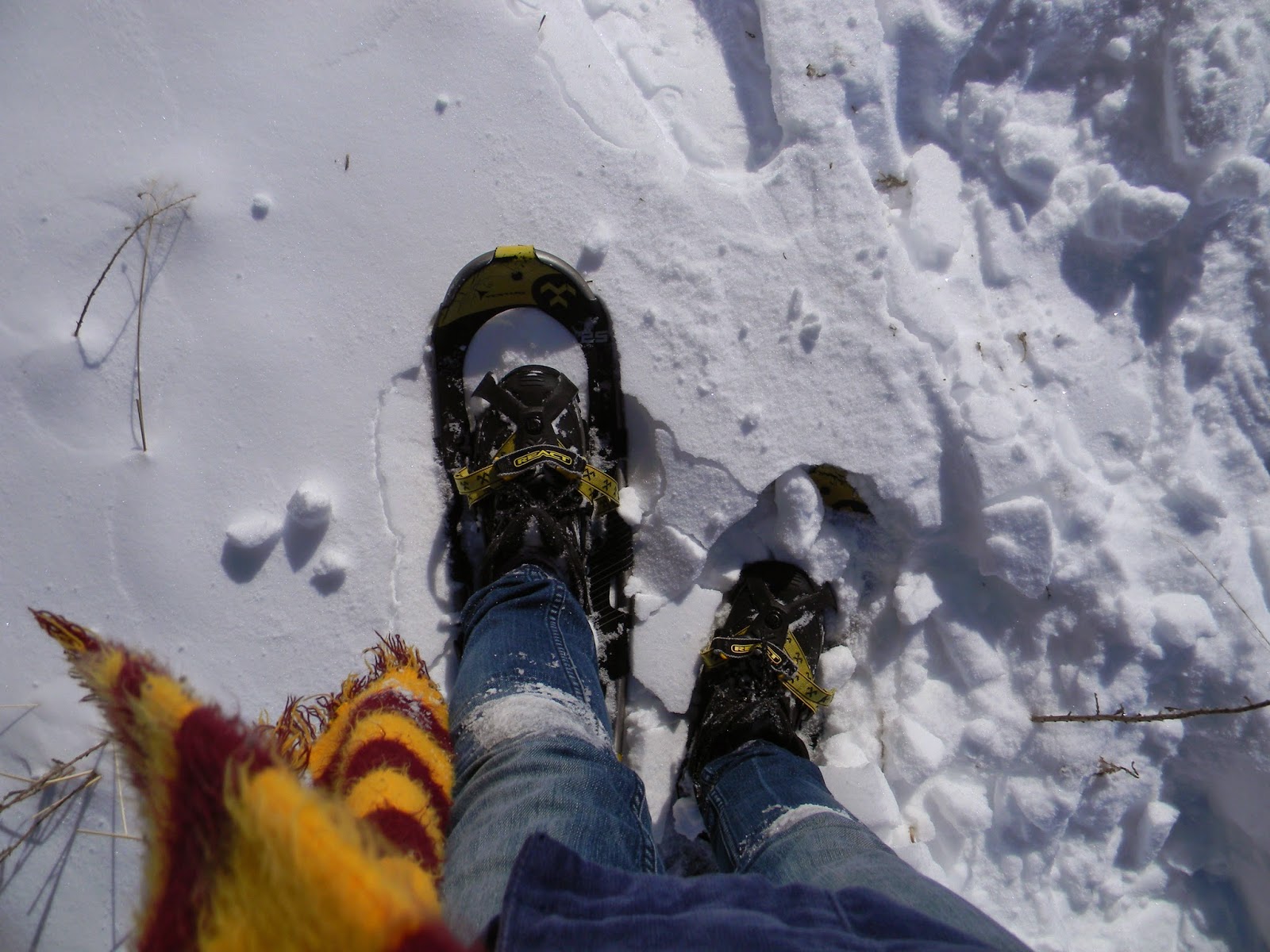
The fifth graders that I work with went in search of animal prints and also to learn how to snow-shoe.  They had practiced identifying some signs of animal life (prints, fur, scat, holes in the snow) but now they had to learn how to put on their shoes and move around.  So we staged the first snow-shoe Olympics.  They learned the basic skills they'd need to maneuver through the snow with extra big feet.

 I also didn't know how to snow-shoe, so I wasn't any better than the fifth graders.  If anything, I was worse because I get so nervous.  I hate falling.  More than the average person does, I think.  Other people are normal and they don't let the prospect of falling stop them.  I do.

I took one set of ice-skating lessons when I was younger.  I remember that there was this girl named Bridget who noticed that I was absolutely terrified to do even the most basic ice-skating move-- skating.  She held my hand every time we had to skate across the rink.  I still can't skate confidently.

This fear translates to just about any activity where I'm not on my own two feet-- roller skating (I can't roller blade), ice skating, and snow-shoeing.  I was nervous, especially going down hills.  I was terrified that I'd fall, but more terrified that I'd fall in front of my fifth graders like a doof.  But when one of my fifth graders, Vanessa turned around and asked me if I was okay (since I was really falling behind), I decided to suck it up.  If I fell, I fell.  The fifth graders knew that this was new to me.  They'd already fallen a billion times between everyone in the class, what was one more fall made by an adult?  So I sped up a little bit.  Then we stopped, realizing that having a group of about thirty kids piled together looking for animal tracks just wasn't working.  So the student teacher and I were the leaders of one group of kids.  That's when I was forced to take up the front.  That required that I move at a good pace, making me let go of any fears that I had.

I think I let go of fear under pressure.

This was a great opportunity for the fifth graders and me.  Snow-shoeing was so much fun.  I'm now an expert at putting snow-shoes on (so many kept popping off, it was ridiculous).  I can't wait to go snow-shoeing again, although hopefully that won't be for many, many months.  It's time to let spring have a chance!

Thanks for Reading!

--Jude

Monday, April 28, 2014

A Review of 'Anne Frank: The Anne Frank House Authorized Graphic Biography' by Sid Jacobson and Ernie Colon

"Drawing on the unique historical sites, archives, expertise, and unquestioned authority of the Anne Frank House in Amsterdam, the New York Times bestselling authors Sid Jocobsom and Ernie Colon have created the first authorized graphic biography of Anne Frank.  Their account is complete, covering the lives of Anne's parents, Edith and Otto; Anne's first years in Frankfurt; the rise of Nazism; the Frank's immigration to Amsterdam; war and occupation; Anne's years in the Secret Annex; betrayal and arrest; her deportation and tragic death in Bergen-Belsen; the survival of Anne's father; and his recovery and publication of her astounding diary."

I'm not even sure how I found this, but when I did find it, I was in love and I just had to have it.  A graphic novel-style biography of Anne Frank?  Yes please!  I mostly got this to read in the event that I have a classroom of my own and I want to teach The Diary of Anne Frank.  I think this graphic novel would make great supplementary material.

This book provides not only information about Anne's diary and about life and the people in the Secret Annex, but it provides historical context-- what Hitler has taken over, who's involved in the war now, which territories are in the most danger, etc.-- and it provides history that Anne doesn't really provide in her diary.  It even talks about what happened after the Franks and the van Pels were arrested and sent to various concentration camps around Europe.

If you're looking for a version of Anne Frank's story in more context, this is a great resource (teachers, I'm looking at you).

The pictures are great, the order everything was put in makes sense... I think this book will make kids excited about learning about Anne Frank and her diary.

I give 'Anne Frank: The Anne Frank House Authorized Graphic Biography':
Thanks for Reading!

--Jude