Sunday, March 13, 2016

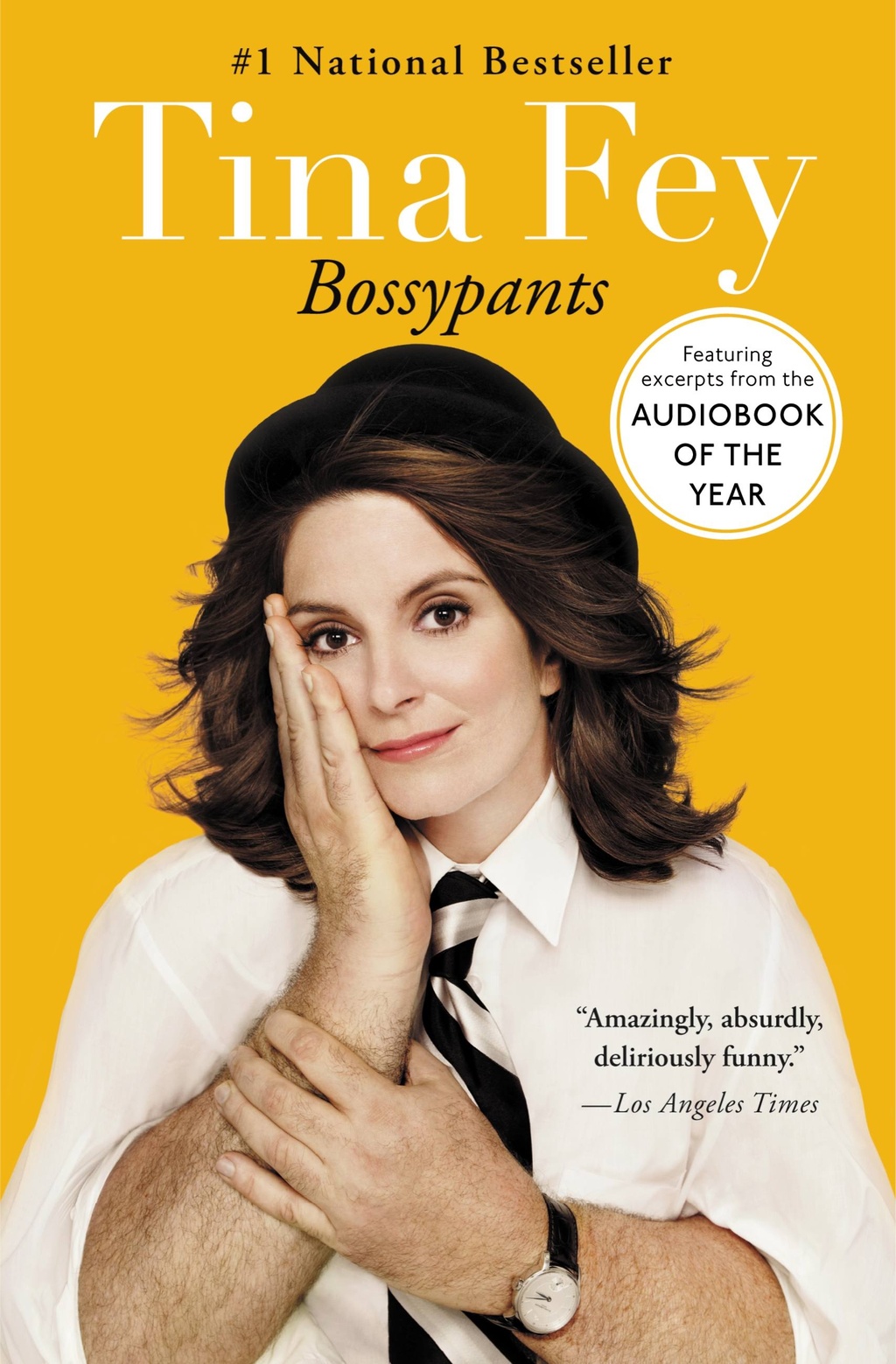
A Review of 'Bossypants' by Tina Fey

Note: this is one of a few reviews that I am trying to write and post before I start in on things that I have read in 2016.  Thank you for your patience!

"Before Liz Lemon, before 'Weekend Update,' before 'Sarah Palin,' Tina Fey was just a young girl with a dream: a recurring stress dream that she was being chased through a local airport by her middle-school gym teacher.  She also had a dream that one day she would be a comedian on TV.

She has seen both these dreams come true.

At last, Tina Fey's story can be told.  From her youthful days as a vicious nerd to her tour of duty on Saturday Night Live, from her passionately halfhearted pursuit of physical beauty to her life as a mother eating things off the floor; from her one-sided college romance to her nearly fatal honeymoon-- from the beginning of this paragraph to this final sentence.

Tina Fey reveals all, and proves what we've all suspected: you're no one until someone calls you bossy."

This book has been on my radar for quite some time, but it was only until a few months ago that I started to read this book.  After listening to Amy Poehler's memoir, I was a little disappointed, but Tina Fey's book was quirky in ways that Amy's wasn't.  It's a little hard to explain.  I hate to lump Amy and Tina together, but I'm going to do it any way.

I appreciated the path that she took to get to where she is today.  What was interesting to me is that she came from a background where she wasn't the best performer, but she loved what she was doing while she worked her way up in the improv world, making it into Second City and into Saturday Night Live in not the most expected way.  She didn't have the predisposition to be in entertainment, but she found what she loved and chased it down mercilessly.  I think that's admirable.  Certainly there were hiccups along the way, but who doesn't have those?

I loved Tina Fey's views on motherhood towards the end of the book.  As someone who is not a mother but is the age where everyone around her is magically having children it seems, I've thought a lot about what it means to be a mother.  I love that she took time to be with her daughter and didn't apologize for it.  I love that she kept pursuing her work and didn't let her identity split between being a mother and being a writer/performer.  This is a very real struggle I've noticed for mothers, maybe even especially fairly new mothers.  You want to be there for your child, watch them grow and support them, but you can't completely lose yourself in the process.  So how do you strike a good balance?

I wish that I had written about this book a little bit sooner or taken notes on it after I read it... I'm having a little trouble remembering my thoughts and feelings on this book.  I do know that it was a fascinating read.  I enjoy reading the stories of well-known people to see how they got to the position they are in life.  I love hearing their wisdom.  Tina Fey has an interesting life and is full of wisdom that I can only aspire to have as I get older.  You will not regret reading this book.

I give 'Bossypants':
Thanks for Reading!

--Jude

Sunday, February 21, 2016

A Review of 'The Miniaturist' by Jessie Burton (Audio Book)


Note: This is one of the few reviews that I am trying to write and post before I start in on things that I have read in 2016.  Thank you for your patience!

"'There is nothing hidden that will not be revealed...'

On a brisk autumn day in 1686, eighteen-year-old Nella Oortman arrives in Amsterdam to begin a new life as the wife of illustrious merchant trader Johannes Brandt.  But her new home, while splendorous, is not welcoming.  Johannes is kind yet distant, always locked in his study or at his warehouse office-- leaving Nella alone with his sister, the sharp-tongued and forbidding Marin.

But Nella's world changes when Johannes presents her with an extraordinary wedding gift: a cabinet-sized replica of their home.  To furnish her gift, Nella engages the services of a miniaturist-- an elusive and enigmatic artist whose tiny creations mirror their real-life counterparts in eerie and unexpected ways...

Johannes' gift helps Nella to pierce the closed world of the Brandt household.  But as she uncovers its unusual secrets, she begins to understand-- and fear-- the escalating dangers that await them all.  In this repressively pious society where gold is worshiped second only to God, to be different is a threat to the moral fabric of society, and not even a man as rich as Johannes is safe.  Only one person seems to see the fate that awaits them.  Is the miniaturist the key to their salvation... or the architect of their destruction?

Enchanting, beautiful, and exquisitely suspenseful, The Miniaturist is a magnificent story of love and obsession, betrayal and retribution, appearance and truth."

I have been looking for more books that take place in the Netherlands or at least are about the Dutch.  When I heard about this book, I was so excited, especially after taking a Dutch history class and learning more about this time period, when the Dutch East India Trading Company was basically the center of the Netherlands' rise to economic power during the Golden Age.

I loved walking through Amsterdam with the main character, Nella, because even though we were in Amsterdam at very different times, I still managed to recognize some places and I could kind of imagine where in the city she was.  I knew where the old city hall was because I walked through it with my French sister Marie when she came to visit me.  I know what the canals look like and I miss them, even just a little bit, every single day.  This was a very nostalgic read for me, if you can't tell.

There were a couple parts of this story that just jumped out and surprised me.  Since this is a blog where I'm not very good about hiding spoilers (books are meant to be talked about), you've been warned...

I didn't expect Nella's husband to be gay, but I was so drawn in once Nella's life possessed this amount of danger and adventure (because otherwise she didn't do very much... women who married into families like the one she married into didn't have to do a lot during this time).  I knew that it wasn't seen as a good thing to be gay, but I don't think I fully realized just how dangerous it was.  For the person who is gay, you can be killed and for the family, you're severely disgraced.  But it was scary how Johannes' sister, Marin, pulled Nella aside and told her that she could tell absolutely no one and that they had known about Johannes even before he and Nella were married.  They wanted to provide her a comfortable life so that Johannes could be spared.  That's how desperate life was for gay and lesbian people.  It's shocking, though not surprising, if that makes sense.

Race relations were another tense area of this book.  I think what surprises me about the areas of race and sexuality in this book is that I'm seeing how these people are treated as opposed to being told that "This is how black/gay people were treated at this time."  It's like being a witness, even though the story is fictional.  Being a witness is scary, to say the least.  Towards the end of the book, we find out that Marin is pregnant (astonishingly, she was able to hide her entire pregnancy... I don't understand...) and when she gives birth, it's clear that of the people the family knows there's only one potential father: Otto, the manservant who happens to be black.  He is no where to be seen at the end of the novel because it's not allowed for him to have any kind of intimacy, especially sexual intimacy, with a white woman.  It's dangerous for him to be around.  And I think that that really hit home with me too, seeing and in a way being part of the environment that was so dangerous for him.  Not much has changed...

This is a book that I can't wait to find and put on my personal shelf (if I ever find the space to do so).

I give 'The Miniaturist':
Thanks for Reading!

--Jude

Saturday, February 20, 2016

A Review of 'Horten's Miraculous Mechanisms: Magic, Mystery & A Very Strange Adventure' by Lissa Evans

"Enter a wonderful world filled with real magic, mystery... and danger.

As if being small for his age and also having S. Horten as his name isn't bad enough, now 10-year-old Stuart is forced to move far away from all his friends.  But on his very first day in his new home, Stuart's swept up in an extraordinary adventure: the quest to find his great-uncle Tony-- a famous magician who literally disappeared off the face of the earth-- and Tony's marvelous, long-lost workshop.  Along the way, Stuart reluctantly accepts help from the annoying triplets next door... and encounters trouble from another magician who's also desperate to get hold of Tony's treasures.

A quirky, smart, charming page-turner, Horten's Miraculous Mechanisms will enchant young readers-- as well as teachers, librarians, and parents."

I am back with my fifth graders!  This was the first book that we finished reading.  I was attracted to this book by the cover art and the art that appears at almost every chapter.  What kept me reading was, even though I had an idea what was going to happen next a lot of the time, I always wondered how the characters would handle the next situation thrown at them.

I didn't particularly care for the characters... they felt rather flat to me.  Stuart could go from zero to sixty in a flash if the situation were right, the triplets fell into the stereotype that all triplets are the same person times three, Stuart's father was annoying and had unnecessarily complicated syntax when he spoke, and his mother was just distant the whole time... overall, I'm not terribly impressed.  But the plot was interesting because it challenged me to always think a step ahead.  I know my fifth graders appreciated this challenge too.  They really liked the book and when I told them that there was a sequel, they demanded to read it next (which we're not, but perhaps before the semester ends).

This book is very much for younger readers, but as the person reading the book with them and talking about it book-club style, it was still a nice read.  Just maybe not something that I would feel compelled to read again or put on my own shelf at home.

I give 'Horten's Miraculous Mechanisms':
Thanks for Reading!

--Jude

Wednesday, January 20, 2016

A Review of 'I Will Always Write Back: How One Letter Changed Two Lives' by Caitlin Alifirenka and Martin Ganda

Note: this is one of a few reviews that I am trying to write and post before I start in on things that I have read in 2016.  Thank you for your patience!

"The true story of an all-American girl and a boy from an impoverished city in Zimbabwe and the letter that changed both of their lives forever.

It started as an assignment.  Everyone in Caitlin's class wrote to an unknown student somewhere in a distant place.  All the other kids picked countries like France or Germany, but when Caitlin saw Zimbabwe written on the board, it sounded like the most exotic place she had ever heard of-- so she chose it.

Martin was lucky to even receive a pen pal letter.  There were only ten letters, and forty kids in her class.  But he was the top student, so he got the first one.

The letter was the beginning of a correspondence that spanned six years and changed two lives.

In this compelling dual memoir, Caitlin and Martin recount how they became best friends-- and better people-- through letters.  Their story will inspire readers to look beyond their own lives and wonder about the world at large and their place in it."

I remember picking up this book over the summer when I went on a walk with a little girl and her adorable dog.  My home city and my adopted one are both cool because they have these things called Little Libraries scattered throughout the city in front of businesses and private homes.  I once saw one that looked like the TARDIS from Doctor Who!  But any way, I happened upon this book on our walk in her neighborhood.

This book starts with a simple class project of writing to pen pals around the world.  Each student in Caitlin's class picks a country and writes a letter to someone their age.  They don't know a name, they don't know if they're writing to a boy or a girl... the person on the other side of their correspondence is a mystery.  Caitlin's friends all write to someone in part of Europe.  Caitlin was drawn to Zimbabwe and it was the best decision she ever made for her life.

Martin Ganda was at the top of his class, but struggled to stay in school financially (since he had to pay to go to school).  He was lucky to receive Caitlin's letter.  Had his grades been lower or if he had failed a test or two, he might not have gotten Caitlin's letter.  One thing that I love about Martin is his curiosity towards Caitlin's life in the U.S.  He never complained to Caitlin about the problems he and his family were facing, even though days would go by where his mother would give up food so that her children could live.  When Caitlin asked to see a picture of him, he went and fo und the only picture his family had of him and he sent it to her.  He didn't stop and tell her his situation and that pictures were very expensive.  It's awfully big of him, especially since this is a facade that can be difficult to keep up, and eventually it did become too hard to keep a secret.  

It felt a little odd that Caitlin's family was supporting Martin's family.  I know that they were financially able to support Martin's family and that it was something that they wanted to do... I also know that that helped change Martin and his family's lives forever and that they were extremely grateful... but I have this idea in my head, maybe from something at church where we were talking about relief work and how the best way to help someone is to teach the people in the area that is being relieved a skill.  You can feed people fish and they won't go hungry now, but if you teach them how to fish, they'll never be hungry.  That sort of mentality.  This story didn't match up with this idea in my brain.  But I think what made me feel a lot better was that that support shifted from Caitlin's family to Martin as he finished school and started to go out and show the world what a gifted guy he is.  He's ridiculously good with numbers!

I admired Martin's drive throughout the story.  His drive to not only do well in school, but stay in school and get caught up when he fell so far behind from not being able to pay his tuition to stay in school.  He was resourceful and extremely motivated in a way that a number of students in first world countries (I'm sorry, I don't know a better term) just aren't.  We take our education for granted, whether that is the education we're legally obligated to receive or whether it's higher education at a university, technical, or trade school that we opt to receive.  That was a big thought that ran through my head as I was reading this book.  

I haven't really had a successful pen pal relationship in my life, but this book made me think a lot about the international relationships that I have made and how important those have been in shaping how I think about the world.  It's so cool to read about international connections like the ones that Martin and Caitlin made.  This was a really great read.

I give 'I Will Always Write Back':
Thanks for Reading!

--Jude

Wednesday, January 13, 2016

A Review of 'The Spirit Catches You and You Fall Down: A Hmong Child, Her American Doctors, and the Collision of Two Cultures' by Anne Fadiman

Note: This is one of a few reviews leftover from 2015 that I am trying to write and post before I start in on things that I have read in 2016.  Thank you for your patience!

"Lia Lee was born in 1981 to a family of recent Hmong immigrants, and soon developed symptoms of epilepsy.  By 1988 she was living at home but was brain dead after a tragic cycle of misunderstand, over-medication, and culture clash: 'What the doctors viewed as clinical efficiency the Hmong viewed as frosty arrogance.'  The Spirit Catches You and You Fall Down is a tragedy of Shakespearean dimensions, written with the deepest of human feeling.  Sherwin Nuland said of the account, 'There are no villains in Fadiman's tale, just s there are no heroes.  People are presented as she saw them, in their humility and their frailty-- and their nobility."

I had a hard time with this book at times.  I loved learning about Hmong culture and it was interesting to read about how Hmong culture and people are adapting to life away from Laos and Cambodia (because that's largely what this book was about-- the people who emigrated with their families away from the places they called home).  It was incredible to read about how people, especially the children, but even the adults, straddled two cultures at once and managed to keep the culture they brought with them intact, though with some adjustments.

I leave this book thinking everyone is at least a little bit at fault.  I'm disappointed in the hospital for not putting translators at a higher priority, especially when they are fully aware of the demographics of the community that they serve.  They knew that there had recently been a huge influx in the Hmong population.  Instead, what was happening was that nurses aides and technicians at the hospital were being hired, especially if they could speak Hmong, and then they were being used as translators on top of the jobs they were originally hired to do.  I don't know how anyone can be expected to do their hospital tech job and then stop that work and go translate for a family and be expected to do well at all of these things and also, I think, not be properly compensated for doing these two jobs for the hospital.  Both of these jobs are important, but they require a lot of time and different skill sets that aren't necessarily related to each other.  It's not fair to those people.

On the other hand, it also bothers me that the Lee family didn't know even basic words of English that might have helped the doctors diagnose Lia.  If not before the first visit, at least for the subsequent visits before she had an established medical record and a reputation.  Words like "hot," "shake," or "asleep" might have helped the doctors know that she was unconscious and that she had been convulsing (for how long, that's something that the doctors would have to figure out, but at least they'd have some clues).  I think it was especially important to have these words, especially since Lia kept being admitted into the emergency room again and again for the same problems.

The hospital also got too frustrated with the Lee family.  I know that they didn't have a good amount of background knowledge on Hmong culture and beliefs, but you'd think the doctors and nurses would glean that their culture was different than the one the hospital and many of the staff are part of.  Clearly, they can't handle Lia Lee's case in the same way as they can with white patients.  I noticed that towards the end of the book, they had worked themselves into kind of a routine with Lia and as a result, sometimes they became careless.

The family is also quite stubborn.  I became frustrated with some of their interactions with the hospital.  My feeling is that when you come to the hospital, you're recognizing that the situation at hand is bigger than what you can handle and so you go to the doctors who are much more equipped to handle these big situations.  The patient and/or their family ultimately gets to make the choice what happens, but it's the doctors job to use their knowledge to advise the patient and their family in order to help them get well.  It's not the family's job to tell the doctors that they're not doing their job.  That is my biggest point of contention with the Lee family.

As far as language is concerned in this book, I was happy to have my soon to be mother-in-law to talk to about this, as she had read this book for one of her college classes (as I was supposed to have done in my anthropology class, but didn't until a couple years later).  At one of her former churches, they had a decent-sized Koren (Kuh-Ren) population and so the church offered English classes to help these families accomplish basic tasks like grocery shopping and going on a doctor's visit (or other things like that).  I can't remember the question that she asked, but it was something about why they didn't learn some English a little sooner.  Not a question asked in an accusing way, but one that was asked out of curiosity and that was how it was taken.  The answer was basically that they lost their home and they didn't want to lose their culture and native language too.  To me, that's makes sense, but I am having trouble marrying my thoughts on these separate matters together as one coherent thought on the matter.  It seems that there are no winners in this situation and this is something that I need to accept and take into consideration.  I've determined that it's impossible to pick one side, especially when you don't completely agree with how they conducted themselves or how they contradict the "opposing team," so to speak.

I would recommend this book if you don't know a lot about Hmong culture and their history and I would also recommend it if you need a huge issue to chew over for a while.  I don't feel done with this book.  It's given me a lot to think about, absolutely.

I give this book:
Thanks for Reading!

--Jude
Monday, January 11, 2016

Four Reasons Why You Should Study Abroad (Any Where)

At the end of August 2014, I found myself on a plane going from Minneapolis to Amsterdam, where I would catch a train and go to Leiden, the Netherlands and spend the next four and a half months there.  I was scared out of my mind upon landing, but living in Leiden became the best experience I could have asked for.  I know that a number of other people who decide to study abroad feel similar by the end of their experience.  With that, here are __ reasons why you should consider studying abroad, whether that means this coming spring semester if the deadlines haven't passed or in the summer or fall, depending on your program.

1. Explore the Places You've Only Read About or Seen in Movies.  Since I lived in Europe and near a big international airport (Schipol Airport), the world was my oyster.  I ended up visiting eight countries (if you include the Netherlands and also if you include Vatican City, which is a city state) during my semester abroad.  I went to the top of the Eiffel Tower in Paris when my family came to visit, I saw the Colosseum on my 21st birthday, I saw Brandenburg Gate in Berlin when my fiance came to visit, I went through the Anne Frank House twice while living in the Netherlands.  Being in these places in person is so much better than keeping at a distance with books and films.  It's very hard to describe.

2. Get to Know Yourself Better.  This is a very important one.  While living abroad, you're usually away from your family and people you know and so you have to figure things out on your own.  You learn your limits-- things that you're okay and comfortable with and things that you're not okay with and may even make you feel unsafe.  My solo trip to England comes to mind immediately.  I was comfortable using the Tube and finding my way around London on a map, but I was not comfortable staying out after dark in this strange city while I was on my own, so I made sure to be back at my hostel by then.  On a more positive note, you learn about what you're capable of.  I never thought that I would be able to walk into a grocery story in the Netherlands and not speak a word of English while I found my food and checked out with an actual Dutch person.  If you can't tell, I'm still very proud of myself for this.  You also learn what it important to you when you learn about a part of history or a culture that truly moves you or when you prioritize going to see one thing over another when you visit another place for a short while.

3. Live Like a Local.  If you've been living in roughly the same place all your life, it can be hard to fathom what it's like for other people around the world to live in their day-to-day life.  When you study abroad with a program that doesn't do everything for you, you shop at the same grocery stores that local people shop at, you know when market day is, you celebrate the holidays as they are happening in the city... you basically become one of the locals, if only for a short period of time.

4. Learn a Language.  There is nothing like total immersion when it comes to learning a language.  Doing DuoLingo or even studying a language in school can compare to total immersion.  My experience is probably not the best example, because a number of Dutch people speak English, especially in the University town where I lived, but for people who live in smaller cities abroad or who find the special pockets of the big cities and practice what language they know will be able to practice with native speakers and you try and work out what you want to say and what other people are saying to you.  I won't say that there is no "out" to using the native language of the place where you're living, but there are fewer opportunities for switching to English that if you were doing DuoLingo or studying at school.  You struggle through the interaction, but you're a lot better speaker of that language for it.

There are a million reasons why you should absolutely study abroad, but here are four you should take into consideration as you prepare for your great adventure!

Thanks for Reading!

--Jude


Friday, January 8, 2016

Book Blogger Hop: The Evolution of a Blog


Book Blogger Hop
Hello there!  I haven't done a blog hop for quite some time-- I'd like to get back into doing them every couple of weeks or so.  If you're new here, I go by Jude on this blog.  I've been reviewing books for around five years now.  My taste in books tends not to be books that are making headlines (at least not right away), but rather books that interest me.

The question for this week comes from Elizabeth at Silver's Reviews:

Have you made any improvements on your blog since you started your blog?  Did you change the format?  Did you change your header?  Did you add or remove items from your sidebar?

My blog changes quite frequently (and by frequently, I mean every three to six months).  I tend to look for a space of time where I can revamp absolutely everything on my blog at once and then I leave it until I get tired of looking at it or just need a change.  Right now, my current layout reflects an older me who is a bit more experienced in life.  When I started this blog, it was horrendous.  Layout didn't really matter to me, so I splattered the page in content and if I remember correctly, my blog was full to the brim with... stuff... I like to think it's a little cleaner now.  My first layout reflected the fifteen/sixteen year old me while this layout reflects how I feel I am as a twenty-two year old.  It's an odd transformation.  There are very few elements that have no been changed since the beginning of this blog.  But I think that's healthy, since people change over time.

If you're interested in reading reviews that I have written, there is a button below the header that says "Book Reviews" and also a tag in the "Cloud of Labels" that says "Reviews-- Books" where you can browse write-ups on books that I've read to your heart's content.

If you're stopping by on the blog hop, feel free to leave a nice message with your url and I'll do my best to come and visit you during the blog hop!

Thanks for Reading!

--Jude

Friday, January 1, 2016

Blogging and Life Goals for 2016

2015 is finished and now it's time to start looking forward into 2016.  I have a good feeling about this year and I have some decent hopes for it as well.  Here are some goals that I would like to accomplish over the course of this year:

Blogging/Reading Goals

  1. Read/Listen to 60 Books.  I have accomplished reading over 50 books in a year before, so now it's time to up the ante a little.  At the time I am writing this, I have about 250 written reviews.  My goal this year is to, at the very least, break 300 reviews written and published on this blog.
  2. Blog Regularly (Have a Schedule).  This has been my greatest weakness on this blog.  I kind of blog whenever I please, but I think I'm realizing that I do better when I have a deadline.  So for 2016, I am going to do my best to stick to posting at 3pm my time on Wednesdays.  I am going to mark this on my calendar so that I know.  Occasionally I will have a cool thing going on in my life, so those posts will come up as the events happen and every once in a while, there will be more than one book review in a week.  I can't say right now when those times will be, so you'll be just as surprised as I am.
  3. Watch 20 New Movies.  Maybe it's because I recently saw Star Wars Episode VII: The Force Awakens in theaters for the second time and had such a strong reaction to it, but I want to start writing about movies again.  I did this a while ago, but it petered out rather quickly.  I'd like to give this a try again.  Because this is my second attempt doing this, I will not have a specific schedule for writing about movies.
  4. Keep Blogging About Life.  I was scrolling through my previous posts and I really liked being able to look back at my study abroad adventures and things that I did this summer and during the school year.  I feel like there's more of myself in this blog than there ever has been.  I kind of like that.  So I'm going to keep it up.


Health Goals

  1. Get Serious About Food.  I've been learning something about myself lately.  Food is kind of important to me.  I like eating food, but it's also largely the source of how I feel about myself.  If I feel like I've eaten too much unhealthy food in a day, my mood tends to suffer.  This isn't going to be a diet-- I'm not going to adopt the paleo diet or drop carbs altogether or anything extreme like that, but I want to make better choices and do it for the sake of my own happiness.
  2. Develop An Exercise Routine and Stick To It.  How many years have I (and everyone else on the planet) posted something like this?  It's ridiculous that I always find an excuse for not exercising or doing it for a while and then stopping for no reason.  I want to get serious about making this a thing in my life.  I like to bike, walk, and do yoga among other things.  Now I just need to make them routine.
  3. Be Cleaner.  Another thing that I've learned about myself is that my mood really improves when I'm living in a clean and calm environment.  The problem is, I'm not very good about keeping my environment clean.  So I want to develop a list that I must look at right before bed and I'm not allowed to go to sleep until that list is complete.  Something I learned from reading The Happiness Project by Gretchen Rubin is that once the deep cleaning is done, as long as I keep up with the daily mess, I'll only spend 5-10 minutes cleaning every day as opposed to several hours every few months.  It worked for her, so I really want to try this.
  4. Take Care Of Your Brain.  My professor for one of my capstone classes introduced us to meditation.  One of the extra credit assignments was to try and develop a meditation practice.  Since there was nothing to lose, I decided to give it a try.  And I felt a lot better doing it.  It helped with anxiety and my head felt clearer somehow, even though work didn't go away.  I want that feeling back.  I'm going to try and take care of my brain better by giving it time.


Life Goals

  1. Get Married.  Can you believe it, we've been engaged for a little over a year now!  Now it's time to do something about it.  Winter break is probably going to be the time to figure out what is going on with this whole wedding thing.
  2. Graduate.  Right now, I'm slated to graduate in December (one more year!) after I finish student teaching.  I don't anticipate that this will change, but it is getting to be that time when I am feeling more burned out than ever about school.  I put this goal here to remind myself just how important this is to me and also to remind myself just how close I am to being finished with my undergraduate career.
  3. Apply for Teach for America.  I have been talking about this with friends and family and I really think that this is my natural next step.  It will help me get the certification that I want (ESL certification) and help me forgive some of my debt because I'll be placed in a Title I school somewhere.  Again, I have some work to do with this, but I want for this to work out really badly.
  4. Find a Way to Travel.  I kept returning to my study abroad posts throughout this year and I wanted so badly to experience that feeling of having the world open to me the way I did when I lived in the Netherlands.  I don't know if international travel is in my immediate future (as in this year... probably not with a wedding in the works), but I would like to visit places outside of Minnesota at least.  Even if that means going for a long weekend in Chicago by MegaBus.  
  5. Get Published.  There are many opportunities to show off writing and art at my school.  I have one more year to take advantage of these opportunities.  If nothing else, I want to at least send in work to be considered.  There are a number of deadlines coming up in early January, so I'm going to have to get busy.
This is going to be a big year and a great one as well.  I can feel it and I will make it so.

Friday, December 4, 2015

A Review of 'The End Of Your Life Book Club' by Will Schwalbe

"'What are you reading?'

That’s the question Will Schwalbe asks his mother, Mary Anne, as they sit in the waiting room of the Memorial Sloan-Kettering Cancer Center. In 2007, Mary Anne returned from a humanitarian trip to Pakistan and Afghanistan suffering from what her doctors believed was a rare type of hepatitis. Months later she was diagnosed with a form of advanced pancreatic cancer, which is almost always fatal, often in six months or less. 

This is the inspiring true story of a son and his mother, who start a “book club” that brings them together as her life comes to a close. Over the next two years, Will and Mary Anne carry on conversations that are both wide-ranging and deeply personal, prompted by an eclectic array of books and a shared passion for reading. Their list jumps from classic to popular, from poetry to mysteries, from fantastic to spiritual. The issues they discuss include questions of faith and courage as well as everyday topics such as expressing gratitude and learning to listen. Throughout, they are constantly reminded of the power of books to comfort us, astonish us, teach us, and tell us what we need to do with our lives and in the world. Reading isn’t the opposite of doing; it’s the opposite of dying. 

Will and Mary Anne share their hopes and concerns with each other—and rediscover their lives—through their favorite books. When they read, they aren’t a sick person and a well person, but a mother and a son taking a journey together. The result is a profoundly moving tale of loss that is also a joyful, and often humorous, celebration of life: Will’s love letter to his mother, and theirs to the printed page." 


I'm not really sure what I expected from this book before I started, but this book swooped me off my feet and didn't put me down until I'd finished.  By that point, I kind of felt like I'd lost a member of my own family.  Will's stories and retellings of his mother made me feel like I really knew her.  And she was a person you really wanted to know too.  She's really inspired me.  She was always doing something for other people.  She was working to build a library in Afghanistan; she kept in touch with people from all over the world, even just to check in and see how they were doing; she stood firmly by her beliefs, never wavering.  I aspire to be like this author's mother.

'The End of Your Life Book Club' has also reinforced my own feelings about books and the power of reading.  Will would go with his mom to chemo sessions and they would talk about books that they read and would switch and compare thoughts.  This is essentially what they did for years before, but with Will's mother's cancer, there was suddenly a sense of urgency.  Everyone knew that the prognosis was bleak, but as with any life, we never know how much time there actually is.  Novels tend to talk about things that normally we're afraid to bring up in casual conversation.  They open up the floor to talking about difficult subjects like death, pain, suffering... things a handful of us in the world won't ever have to experience.  Nevertheless, there are more people in the world than just this lucky handful.  In order to be better global citizens, we have to understand the experiences of others so that we might better help them.

I love how out of all things, it was books that brought Will and his mother though.  That's another one of my favorite things about books.  I've always been fascinated with people who aligns themselves with books because they found such a love for them.  Take fans of Harry Potter for instance: they call themselves Potterheads and they have created such a community for each other.  I don't know that I've seen anything quite the same since those books were published.  

This is a book that I would like to read again and even keep on my already overflowing bookshelves.  I read this book a year ago and finished while I was visiting England and still, this book has stuck with me.  It's so heartfelt and I haven't read too many books where the mother and the son have a strong connection as these two did.  That's very special.

I give 'The End Of Your Life Book Club':
Thanks for Reading!

--Jude

A Review of 'Panic In A Suitcase' by Yelena Akhtiorskaya (Audio Book)

"In this account of two decades in the life of an immigrant household, the fall of communism and the rise of globalization are artfully reflected in the experience of a single family.  Ironies, subtle and glaring, are revealed: the Nasmertovs left Odessa for Brighton Beach, Brooklyn, with a huge sense of finality, only to find that the divide between the old world and the new is not nearly as clear-cut as they thought.  The dissolution of the Soviet Union makes returning just a matter of a plane ticket, and the Russian-owned shops in their adopted neighborhood stock even the most obscure comforts of home.  Pursuing the American Dream once meant giving up everything, but does the dream still work if the past is always within reach?

If the Nasmertov parents can afford only to look forward, learning the rules of aspiration, the family's youngest, Frida, can only look back.

In striking, arresting prose loaded with fresh and inventive turns of phrase, Yelena Akhtiorskaya has written the first great novel of Brighton Beach: a searing portrait of hope and ambition, and a profound exploration of the power and limits of language itself, its ability to make connections across cultures and generations."

It took me a while to figure out what this book was about.  The story is centered on a Russian family who moves to the United States after the fall of the U.S.S.R. and how they manage to straddle two cultures and keep up with the rules of both.  For me, knowing pretty much nothing about Russian culture, this was a glimpse into that and a little bit of a learning experience for me.  Of course, this family probably isn't representative of all Russian immigrant families, but even so.  More importantly, this book is about what it's like to emigrate and readjust to your new and adoptive home.  The thought of this family seems to be that you need to leave absolutely everything behind when you move away from your country of origin.  But that's not the case.  I don't know if that was the case before, but it's not the case now.  You might leave your home, but your culture is part of you.  You can't just shed it like an old coat and go get a new, more in-style one.  It depends on where you've grown up, I think.  The older generations in this particular family felt the need to move forward and do things the American way, although still hanging on to what I've gathered to be "Russian-isms," since they can't be shed, for better or for worse.  There's a clinging to tradition.  They still celebrate the same holidays that they did, but then there is almost the expectation, particularly for members of the younger generation, like Frida, to take up certain lines of work (Frida attends medical school and hates it). 

Frida was the most interesting to me, particularly as she got a little older.  Even though she lives with her Russian family, she was born and raised in the U.S., surrounded by different mannerisms and traditions and values.  So it's more of a struggle for her to figure out where she belongs.  Is she American?  Is she Russian?  Do her family's values mean the same thing to her as they do to her parents and grandparents?  What does it mean to be a first generation American citizen in her family?  This book is an interesting exploration of these questions.

I don't know yet if this is a book I will pick up again, but it was an intriguing read for now.  Maybe I'll have to read a hard copy version of this as opposed to listening to an MP3 track of the book.

I give 'Panic in a Suitcase':
Thanks for Reading!

--Jude

Friday, November 27, 2015

Thanksgiving 2015

I am fortunate enough to have been around for twenty-two Thanksgiving celebrations and I am thankful that each time, I have been able to celebrate with people I care about and who care about me.  I think especially this year, in light of the terrible things that have been happening in the world and in my own city, it's especially important to take a step back and think about how lucky we are and about the things we are grateful for.  So here are twenty-two things that I am thankful for this year, in no particular order of importance or amount of gratitude:

  1. Understanding Professors.  I don't know why, but this semester has been particularly difficult to deal with... it's not that my classes are excruciatingly difficult, but I've been having trouble keeping track of what work I need to do and that has made me fall behind a bit.  Things have gotten better now, but it was really hard earlier in the semester.  I'm grateful that I have understanding professors to help get me through those rough patches.
  2. My family.  They put up with me for a semester and a summer this year after I came home from Europe.  It was nice to have them to lean back on when I needed help then and it's nice to know that they still have my back if I ever need help or I'm struggling.
  3. My fiance.  I've been discovering that I can be kind of annoying to live with, so I'm grateful that my fiance has been patient and supportive through this transitional time as we continue to adjust to living together and taking responsibility for ourselves.
  4. The Safety Of My Friends Abroad.  One of my French families lives near Paris.  We found out that one of my French sisters was in Paris the night of the Terrorist attacks, but she got in touch as soon as she possibly could and told everyone that she was okay.  I am grateful that all of my friends and family in and around the Paris area are okay.
  5. Having A Place Of My Own.  Getting a place of our own was almost not a possibility until jobs and other circumstances came through for us.  I am very happy to be living in a great neighborhood and living close to other parts of my life (work and school).  I am grateful to have a place that we can mold to our own needs (within reason).
  6. Artemis, My Kitten.  I wanted a cat since we moved in, but I never anticipated how much having an animal around can improve a person's mood and lower stress levels.  I am thankful for this kitten for improving my mental health and for bringing a smile to my face every single day.
  7. Having Work That Helps Me Pay My Bills And Keeps Me On My Toes.  I am lucky to have a job, and I'm even luckier to have several so that I can pay my half of the bills and still have something leftover.  Some of my jobs are mentally draining, but I am happy that they are jobs that generally involve me thinking quickly and making good decisions.  I never want to work for retail again... that was just awful...
  8. Down Time.  For the longest time, I didn't really have down time, not even on the weekends.  Now that I'm not as busy as before, I have more down time and it makes a world of difference in my mental state.
  9. Good Books To Read.  I have access to two libraries in my neighborhood and between the books I own and the ones that are my fiance's, we have a killer collection of books right here in our apartment.  That's really special.
  10. People Who Risk Their Lives To Do What Is Right.  I am grateful that there are people out there who are willing to risk their lives and fight for human rights for everyone.  It's a really important cause, but also a dangerous task.
  11. Clean Smells.  Seriously, my heart gets happier living in a place that doesn't smell funky.  And when I work in an area that doesn't smell like dirty diapers and child drool.
  12. Opportunities To Try New Things.  I had the opportunity to be a writer for my University's newspaper and to be a Commuter Senator on campus.  Even though Senate didn't end up working out (I'm not very sad, plus, it's for the best), I'm still happy that I had the opportunity to give it a try.
  13. Having Plenty To Read.  Anyone who has been in my apartment comes in and is immediately taken aback by the sheer number of books that line our walls.  This is my favorite part of my living space.  It makes me happy.
  14. Living Close To My Cousin And My Sister.  Even if I don't see either my cousin or my sister very regularly, it's nice to know that we could get together at a moment's notice should we want to.
  15. Having The Means To Travel.  I haven't traveled since I got back from the Netherlands in January, but I've revisited in my mind so often and I can't help but feel this wave of gratefulness every time I think about everything that I got to see and do in my four and a half months away.  I'm still in awe.
  16. Internet and Social Media.  The internet is how I (and millions of other people on the planet) keep connected and how I accomplish any of my work.  The internet is my lifestyle.
  17. Fieldwork.  Not every day in a high school or middle school is rainbows and unicorns, but every day is a learning experience.  Learning is what I'm in those places to do, ultimately.
  18. Scented Candles.  This goes with the clean smells point, but candles are also relaxing.  Lately I've had a heightened need for relaxation and candles are a nice way to start that process.  I also feel grateful because up until I moved into this apartment, I really didn't feel like I could light candles in my living space.  Either that or it was outright banned in my living space.  So I'm happy that I can now use these.
  19. Art Supplies.  I'm grateful that I have a stash of paint and lots of paper and projects that I can pick up or drop off whenever I'd like to.  Art is another relaxer for me, so it's nice to have it in close proximity.
  20. Planners.  My savior.  I'd be so lost without you.
  21. Chocolate Ice Cream.  I tried so hard to resist this.  I've succeeded at keeping this in my house only sometimes, but it's not gone for good.  And I'm happy that it's not gone for good.  It's a nice comfort treat every once in a while.
  22. Time Spent At Home.  I have been learning this school year that it's not so important for me to be on the go, busy all the time, but it is crucial for me to be somewhere I can charge my batteries.  Being busy for a good chunk of the semester has made me realize how much I like being in my own space, doing my own thing.  This is something that I need and will cherish in my last year of school and beyond.
What are some things, big and small, that you are thankful for this year?

Thanks for Reading!

--Jude

A Review of 'Yes Please' by Amy Poehler (Audio Book)

"In Amy Poehler's highly anticipated first book, Yes Please, she offers up a big juicy stew of personal stories, funny bits on sex and love and friendship and parenthood and real life advice (some useful, some not so much), like when to be funny and when to be serious.  Powered by Amy's charming and hilarious, biting yet wise voice, Yes Please is a book full of words to live by."

This was delightful to listen to, at least most of the time.  On my mom's and my brief trip to Iowa (you can see that post HERE), we put this in the car stereo and it was excellent to sit and laugh until our bellies hurt.  I love listening to autobiographies of well-known people because then, at least in my eyes, celebrities become people.  I think it can be easy to think that if someone is funny or a comedian, they're happy people with happy lives, and that's not always the 100% truth.  So listening to Amy Poehler was a nice reminder of that.  Amy doesn't live a life filled with hardship, but she's had her experiences.  But this isn't the main thing that I will take away from Amy Poehler's "Yes Please."

She does have some good nuggets in this book.  Her advice "Good for you, not for me" resonated with me because it reminds me that we as people are not exactly the same.  She mentioned the phrase while talking about the birth of her first child, but since I'm not at that point in my life right now, I've interpreted this a little differently.  I think you can apply this phrase to anything.  For example: my career aspirations.  I know full well that many, many people are looking for those who studied and majored in some kind of science in college.  Physics, biology, chemistry... whatever it is.  But 1) I suck at science, even if I find it fascinating at times and 2) I tend to get bored while studying science of most kinds, even though I find science interesting outside of an academic setting.  Good for you, those who love and enjoy science and have prospects in one of those fields of work, but not for me.  I've got some English teaching to do.

She had some creative ways to talk about difficult parts of her life that she still wasn't totally comfortable sharing with the world.  For example, her divorce.  I think the only reason she felt she needed to mention her divorce at all was because both she and her ex-husband are public figures.  You know it happened, but you don't necessarily know the details.  And that's okay.  We shouldn't need the details.  But I think Amy handled it as maturely as possible.  She up with book titles related to her divorce if she were ever to write a book  about it (but she probably won't, because as she said, writing a book is hard).  The reason why I say she did this maturely is because the book titles she came up with reflected her feeling about going through divorce without pointing fingers or airing their dirty laundry.  Amy was in control of her story and her situation.

One of the more moving parts that I read, and unfortunately it was towards the end, was when she talked about her outreach trip to Haiti after they experienced an earthquake shattering their already fragile infrastructure.  Even when she was just observing, my heartstrings were being tugged repeatedly because she was observing with the eye of a mother.  When she visited the Haitian orphanage and saw child after child who desperately needed someone-- literally anyone-- to love and care for them.  It' devastating to listen to, although not as devastating as if we were to experience that ourselves in person.

The ending got a little bit preachy when she talked about how phones and modern technology we use daily (smart phones, laptops, etc.) are taking over the world.  In an autobiography about Amy Poehler, I would have liked to hear about another part of her life, not hear Amy get up on her soap box, if that makes sense.

Overall, this was enjoyable to listen to, but after a certain point, the order of the chapters felt strange and I think that contributed to the feeling of this book dragging on.  And this isn't a super long book to begin with.

I give 'Yes Please':
1/2
Thanks for Reading!

--Jude

Thursday, September 17, 2015

A Review of 'Gone Girl' by Gillian Flynn (Audio Book)

"On a warm summer morning in North Carthage, Missouri, it is Nick and Amy Dunne's fifth wedding anniversary.  Presents are being wrapped and reservations are being made when Nick's clever and beautiful wife disappears from their rented McMansion on the Mississippi River.  Husband-of-the-Year Nick isn't doing himself any favors with cringe-worthy daydreams about the slope and shape of his wife's head, but passages from Amy's diary reveal the alpha-girl perfectionist could have put anyone dangerously on edge.  Under mounting pressure from the police and the media-- as well as Amy's fiercely doting parents-- the town golden boy parades an endless series of lies, deceits, and inappropriate behavior.  Nick is oddly evasive, and he's definitely bitter-- but is he really a killer?

As the cops close in, every couple in town is soon wondering how well they know the one that they love.  With his twin sister, Margo, at his side, Nick stands by his innocence.  Trouble is, if Nick didn't do it, where is that beautiful wife?  And what was in that silvery gift box hidden in the back of her bedroom closet?"

A return to gardening this summer signaled a return to audio books.  'Gone Girl' was one I had been meaning to read for a while and just never got around to reading.  But now I have!

***Note: As usual, this review will contain spoilers.  Read at your own risk.***

This book is one of the more engaging books I've ever read.  I've never considered myself much of a reader of mystery novels, but after this... I think I need to try more.  I won't say that I'm hooked just yet.  Give it time.

I am floored by how intricate this story is.  Maybe to be clearer, I should say that I'm floored by Amy's attention to detail.  It's totally ridiculous.  Once you realize just what Amy is doing, you can't help but wonder how she thought about each and every problem that had even the smallest chance of happening and, more importantly, how to avoid it or spin it to her advantage.  She had Nick so cornered that I was more impressed by her level of plotting and cunning than I was creeped out and scared that she would even think to go to these lengths.

Despite how impressed I was, I absolutely hated both Nick and Amy.  I started out only hating Nick, but then I hated Amy closer to the end.  It just turns out that they're both terrible people.  Nick does nothing but think about himself.  He does this by essentially taking Amy away from her entire support system in New York (he doesn't give her a choice in the matter).  This is a big sign of abuse in a relationship.  He also, of course, cheats on his wife with a woman half her age (who also happens to be a student of his, but that's a whole other ethical debate).  Amy has a history of overreacting and has a tendency to ruin the lives of anyone she pleases.  Both are absolutely despicable.  

It's interesting how the stories with the most hateful characters tend to be the most engaging for me (take 'The Curious Case of Benjamin Button,' for example).  

I loved this book up until the ending.  I was at the point where I just wished Amy and Nick would kill each other or get a messy divorce, but no, they dragged a kid into it.  I thought that this had crossed a line.  Someone in my life wisely said that you should not bring a child into the world if they are going to be a punishment that you need to bear.  Nor should a baby be given an agenda from the day it is born.  Nick and Amy's child is given both of these things.  This baby had the agenda to fix this irreparable marriage.  These two 30-something adults can't even fix their marriage in a normal or healthy way, so how can this baby be expected to achieve this desired result?  More importantly, this baby is born out of revenge.  The biggest "screw you" a couple can (but shouldn't) give.  Nick felt obligated to stay and raise his child.  I worry for this (fictional, I know) child born to a selfish father and a sociopath mother.  What kind of a childhood will it have?  Will it get enough attention and love?  What happens if it does something wrong?  How will Amy react?

Despite the ending, this is an amazing book.  I don't know if it's worth rereading when you know what happens, but we'll see.

I give 'Gone Girl':
Thanks for Reading!

--Jude